Have you ever thought of Britain’s national dishes of fish and chips, a roast dinner or a cooked breakfast as mediocre and just a plain old bit of stodge? See my review below of Pete Brown’s ‘Pie Fidelity’ in which he tries to argue that British food is much more than this and even something to be proud of.
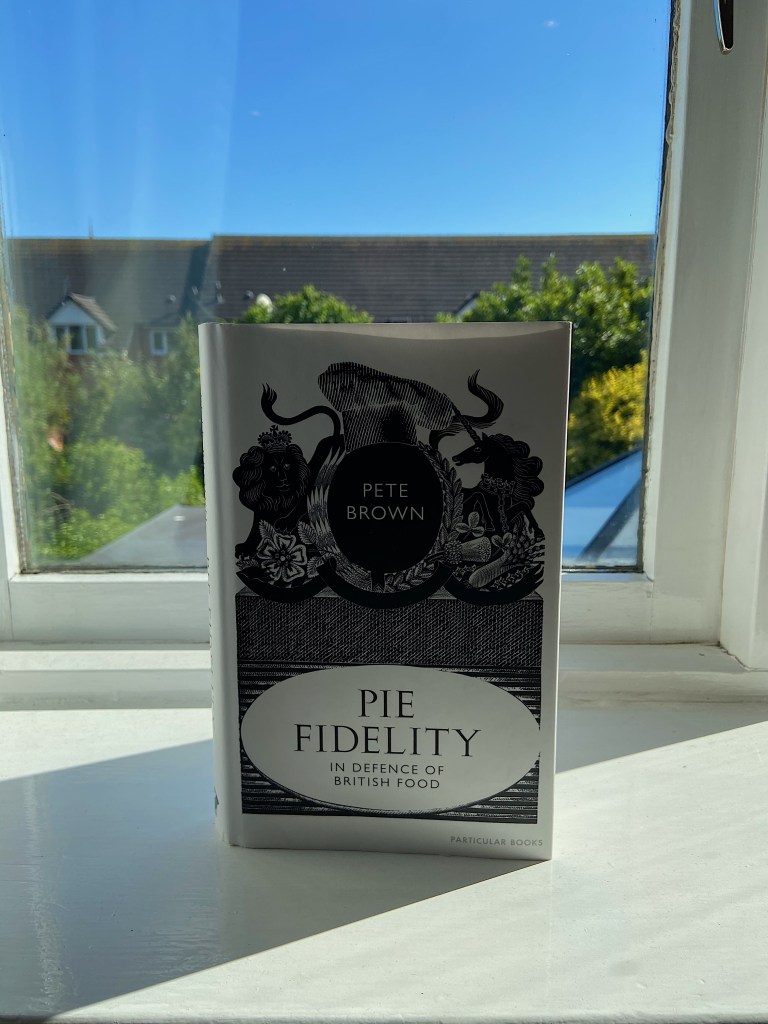
While I, as a strong Cymraes/Welshwoman, am not particularly proud to be British, I cannot deny that the dishes defended in Pie Fidelity are familiar to me. It wasn’t a Sunday in the Lawler house growing up if we weren’t digging into a roast dinner at 6PM in front of Antiques Roadshow and there is no weeknight staple truer to the name than spag bol. The book does mainly focus on English food and geographies. Cardiff’s Chippy Lane (a.k.a. Caroline Street) may get honourable mention in the fish and chips chapter and while each nation’s interpretation of the cooked breakfast does get a shout out I use English/British in this review as let’s be honest, he’s arguing for pride in England’s and not so much the surrounding nation’s food.
The first chapter of Brown’s staunch resistance to the historical critique of British food concerns pie and peas. Not a tradition I, as Welsh and then Bristol Uni attendant, have been exposed to, it being a northern one; the author harking back to his days coming of age in Barnsley. While his nostalgia for this dish can clearly be felt and his sumptuous descriptions of a warm pork pie nestling on top of peppered mushy peas would convert even me, a pork pie sceptic, this chapter felt confused, consisting of content as well as introductory fodder and statistics.
With the introductions out of the way however, Brown’s rhetoric comes to life, going onto perfectly display the beauty in the simplicity of the cheese sandwich in his second chapter. Whether it’s paired with ham, pickle, tomato or onion, toasted or baguetted, the cheese sandwich is a truly British lunchtime creation. He urges for us to celebrate British dairy produce and the UK’s amazing cheddar tradition and rightly so, explaining how it was very nearly lost to the world through industrialisation and the nation’s prioritisation of money instead of pride in our champagnes or Parmigiano-Reggianos.
In proceeding chapters, Brown attempts to tackles Britain’s colonial past and appropriation of cultures in the form of the curry and spag bol. An interesting topic and one I had personally never considered before. While pies, roasts and fish and chips were a large part of the food I ate as a child, so were spaghetti Bolognese and curries. Brown asks his friends to make him their versions of the lovingly abbreviated spag bol on a quintessential rainy Tuesday weeknight. Each incarnation varied from one to the other in choice of mince, herbs, tomatoes, wine and well just about every component. According to Brown, the most important definition to make here is that none of their interpretations of this supposedly classic Italian dish claim to be authentic. As many have claimed before, Italians would never eat spaghetti with a sauce like Bolognese and traditionally the ragù would have been made with white instead of red wine. Instead, Brown convincingly claims that spag bol has morphed over time through varying cultural influences into a British classic, using our produce but with the dishes cultural heritage still firmly rooted in forms of regional Italian cuisine.
Brown uses similar arguments regarding Britain’s relationship with the concept of the curry. When served a Balti or a chicken tikka masala alongside your cobras at a curry house he argues what you are being served are ‘Anglo-Indian creations’ (p. 211). In other words, a combination of English and Indian flavours coming together on a plate, created in the 18th/19th century in order to appease British taste buds while enjoying the exciting new flavours from the Indian subcontinent. While he fully acknowledges Britain’s brutal colonialization of India as the reason for curry appearing on our dinner tables today he also claims that ‘curry’, being the British umbrella term for any and all Indian food, is therefore a British staple. Indian food being so regional, where they would refer to dals, dopiazas or biryani’s we would use ‘curry’. While his argument may be valid and his acknowledgement of the curries history important it is still difficult to be proud of and lay claim to a dish that is the product of such a strained, uncomfortable and violent history.
Throughout the book Brown makes some controversial statements. His description of a cream tea’s scone as possibly the driest thing you could put in your mouth, his disgust at any form of cream or his dismissal of thin and crispy bacon as unsuitable are just a few examples. While I don’t agree with all of Brown’s opinions he does make many valid points. In the end he is won over by the delightful cream tea, eating his words in the form of a moist jam and clotted cream covered scone, clever to not get involved in the centuries old question of cream or jam first. Another of his attitudes which I myself hold is his ambivalence towards eggs on a Full English, asking ‘why do they [eggs] dominate the breakfast menu to such an extraordinary extent?’ (p. 236). He asserts the greasy spoon is a British institution and Elmers Crwys Road, if you’re reading this, we can’t wait to come and recover after a heavy night once again.
Possibly his most valiant point of all is his defence of the roast dinner. Brown’s description of the utter chaos and gargantuan effort that is cooking a roast dinner could not be more accurate. His call to hail the roast dinner as a skilful and impressive feet of cookery is one I also endorse, having seen the skill of my mum artfully dance around the kitchen most Sundays for 22 years as she cooks up a storm all on time and still piping hot. The only stress in my house surrounding the roast dinner is whose turn it is to do the washing up.
I may disagree with Brown’s final musings on the humble and self-deprecating nature of the English/British (having been on the receiving end of much over confident, let’s be honest cocky, commentating from John Inverdale and the like during the Six Nations) but this book’s strength lies in his ability to express that food is undeniably intertwined in memory. Brown claims ‘our best meals remain a product of their environment’ (p. 326). The chips and gravy down Barry beach on a crisp Winter day walking the dog are somehow unsurpassable, this nostalgia being a great reason to read Pete Brown’s Pie Fidelity, a controversial, comical, possibly convincing defence of British cuisine.
 erinsseats.food.blog